



New Delhi:
Sushmita Banerjee was all of 25 when she met Jaambaz Khan, an Afghan moneylender, at a theatre rehearsal in Kolkata, West Bengal. It was 1986. Sushmita’s pal performed Cupid. Sushmita and Jaambaz met as soon as every week, for an hour, at Flury’s within the metropolis. Over espresso and a pastry shared between the 2 of them, they acquired to “know” one another.
It wasn’t sufficient, lamented Banerjee later, when she discovered herself in Kharana, deep inside Taliban-ruled Afghanistan, the place Jaambaz took her after their secret marriage ceremony underneath the Special Marriage Act on July 2, 1988. Sushmita was a “Bengali Brahmin” woman. She married “Afghan Muslim” Jaambaz towards her dad and mom’ needs. When her dad and mom found the wedding, they tried to get them divorced; however in useless. Sushmita left Kolkata for Kabul with Jaambaz.
Sushmita was 27 when she married Jaambaz. She didn’t convert to Islam.
Less than three years after she arrived in Afghanistan, Jaambaz was gone. He had left Afghanistan to return to India, the place he had his moneylending enterprise. Sushmita wasn’t knowledgeable. He was gone.; identical to that; as she questioned if the Taliban had completed away together with his head for marrying a Hindu lady.
“He left of his own accord.”
Sushmita stayed behind within the province of Paktika, residing a nightmare, because the Taliban combed the streets and executed any lady who dared to defy orders.
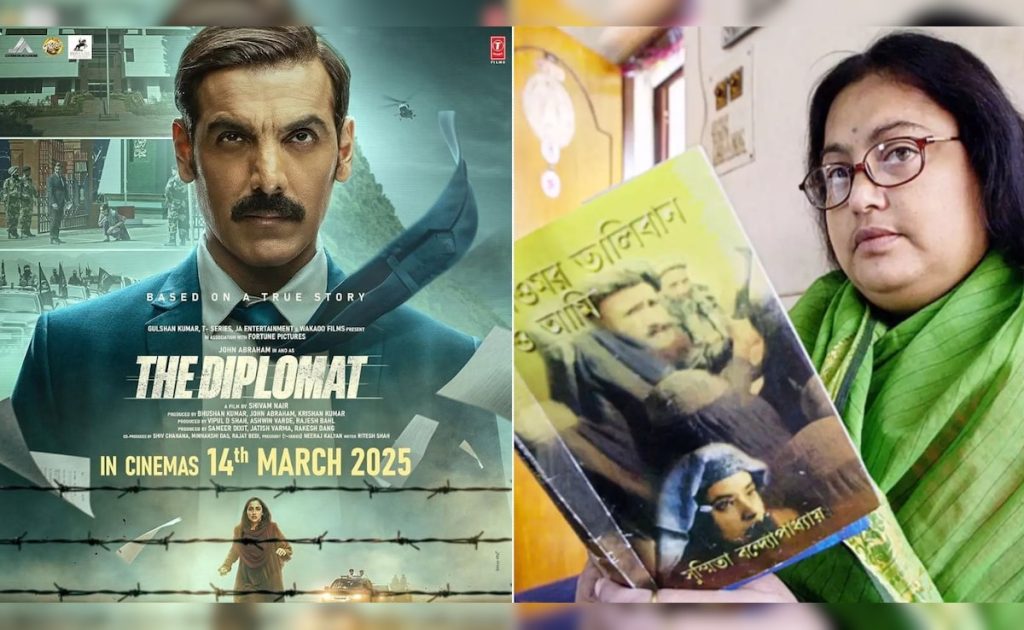
That was a few years earlier than Indian lady Uzma Ahmed discovered herself residing an analogous nightmare in Khyber Pakhtunkhwa in Pakistan; and the story of whose escape is on the massive display within the John Abraham and Sadia Khateeb-starrer The Diplomat this week.
Uzma referred to as herself fortunate to have gotten again to India.
For Sushmita, life performed out somewhat otherwise.
Kabuliwala’s Bengali Bride
Sushmita Banerjee shot to fame in 1995, when the memoir of her daring escape from the clutches of the Taliban made headlines in Bengal and the nation. In Kabuliwala’s Bengali Bride (Kabuliwala’s Bangali Bou, Bengali, 1995), Banerjee recounted intimately how her days within the mountains of Afghanistan have been measured out in screams and torture by her in-laws as soon as Jaambaz was gone. Khan would report audio cassettes from Kolkata and put up them to Banerjee each couple of months. “When the war is over, you will come to India,” was the chorus in them.
When Sushmita reached her husband’s dwelling, she discovered that he had a primary spouse, Gulgutti, whom he married 10 years earlier than her. Sushmita was surprised, however made peace with it.
“Gulgutti was very quiet, shy, and nice. She used to call me Sahib Kamal,” Banerjee informed Rediff.com in 2003. In her guide, she wrote that “Sahib Kamal” in all probability meant “Sahib ka Maal” (Sahib’s Object/Woman). Banerjee lived with Gulgutti, her three brothers-in-law and their wives, and her husband Jaambaz in Kharana until Khan left for India.
Things quickly took a flip for the more serious because the Taliban’s powers and madness grew unchecked in Afghanistan. They made beards obligatory for males and made girls invisible save for with their males. Newspapers have been tossed, radio was banned, and books have been made bonfires of. Men needed to attend the mosque 5 instances a day. Women couldn’t go to the hospital lest a person touched them.
In Khan’s dwelling, Banerjee’s days have been all about “no sleep, starvation, and physical assault”. The abuse by her brothers-in-law ranged from bodily to psychological. There was no finish to it. “They weren’t human,” wrote Banerjee in her memoir, “I’m an unofficial prisoner here. Because this entire country is a jail.”
The Village Doctor In The Eye Of The Taliban
Afghanistan barely had any girls medical doctors. This often meant no therapy for girls. If they fell in poor health, they needed to die at dwelling since hospitals meant male medical doctors and no lady was authorised by the Taliban to be touched by anybody besides her husband.
Sushmita had fundamental coaching in nursing. She had additionally learn up a number of books on gynaecology that got here helpful in these unreachable reaches of Afghanistan, the place girls trusted luck and limericks within the title of therapy. The Taliban had shut down all faculties. No one may examine medication.
It was underneath these circumstances that Banerjee opened her clinic and underneath that cowl, spoke to girls to make them conscious of the injustice meted out to them. Her clinic was found by some males in May 1995. They beat her lifeless… effectively, nearly.
This assault on Banerjee prompted her to make up her thoughts about escaping Afghanistan and returning to Kolkata, the place her household lived.
She was planning an escape from the Taliban. It wasn’t going to be simple.
Escape From The Taliban
First Attempt: Sushmita, with the assistance of some well-wishers that she had within the village, acquired herself a Jeep that took her to Islamabad in Pakistan. She knocked on the doorways of the Indian High Commission; however, a lot to her shock and agony, was “handed back to the Taliban”.
Second Attempt: Banerjee didn’t lose hope. She tried escaping the Taliban as soon as once more. “This time, I ran all night,” Banerjee wrote in her guide. She was arrested once more.
After her second try to flee, the Taliban determined they’d had sufficient of this lady. A fatwa was issued. She was to die on July 22, 1995.
Third Attempt: The village headman, Dranai chacha, preferred Sushmita for her social work. This man’s son had been killed by the Taliban, so he had turned towards them. On the day that Sushmita wished to flee the Taliban for the third time, she grabbed an AK-47 “and shot three Taliban men”, she recounted in her memoir. The headman helped her on to a Jeep and took her to Kabul.
“Close to Kabul, I was arrested. A 15-member group of the Taliban interrogated me. Many of them said that since I had fled my husband’s home, I should be executed. However, I was able to convince them that since I was an Indian, I had every right to go back to my country,” Banerjee wrote in an article for the Outlook in 1998.
“The interrogation continued through the night. The next morning, I was taken to the Indian embassy, from where I was given a safe passage,” she wrote.
She was handed a visa and passport, and she or he took off for Delhi.
It was raining when her flight landed within the Indian capital. From there, she left for Kolkata, the place she arrived on August 12, 1995. Less than three months for the reason that day she made up her thoughts to go away Afghanistan, she was in Kolkata.
“Back in Calcutta, I was re-united with my husband. I don’t think he will ever be able to go back to his family,” wrote Banerjee.
Back To Afghanistan
For the following 18 years, Sushmita Banerjee lived in India together with her husband Jaambaz and labored on her books, a Bollywood movie that starred Manisha Koirala (Escape From Taliban, 2003), and wished to do one thing for the ladies underneath the Taliban. She hoped her movie would make it to the United Nations and they’d intervene.
In 2013, Banerjee celebrated Eid for every week in Kolkata and went again to her husband’s dwelling in Afghanistan. Khan had moved again dwelling in Afghanistan and Banerjee wished to dwell with him. She had additionally transformed to Islam by then and brought on a brand new title, “Sayed Kamala”.
25 Bullets And A Silent Burial
After Banerjee’s return to Afghanistan, she resumed work as a well being employee within the Paktika province. She was additionally filming the lives of the native girls as a part of her work.
The Taliban acquired whiff of it. They confirmed up at Jaambaz’s household dwelling in Kharana, the provincial capital of Paktika on the night time of September 4, 2013, and certain him up. Sushmita was dragged out and shot lifeless. They pumped 25 bullets into her physique, as per a report, and dumped it close to a madrassa.
Banerjee’s in-laws in Afghanistan buried her physique as her brother in Kolkata questioned, “Why did she have to die like this?”
Source link
#Indian #Woman #Escaped #Taliban